
Astronaut Sunita Williams discusses how space travel changed her perspective on life, emphasizing the unity of Earth and the silliness of human conflicts when viewed from space.

Heralding a new era, India on Friday night launched its heaviest commercial space mission ever with its polar rocket successfully putting five British satellites into the intended orbit after a flawless takeoff.

ISRO has announced plans for seven launch missions by March, including the first uncrewed mission for the Gaganyaan project and demonstrations of new satellite technologies.

Astronaut Shubhanshu Shukla returns to Earth after an 18-day mission aboard the International Space Station, marking a significant milestone for India's space program and carrying out crucial scientific experiments.

'The launch of Axiom 04 slated for 11th June 2025 for sending first Indian Gaganyatri to ISS is postponed.'

'This policy is a vision to position Karnataka as the epicentre of India's space ambitions'

Chinese astronauts Jing Haipeng, 50, and Chen Dong, 37, were blasted off into space by Shenzhou-11 (heavenly vessel) spacecraft.
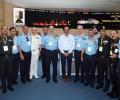
The space agency has redefined the mission in such a way that it will achieve success in the very first attempt.
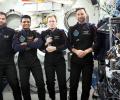
After 18 days of experiments, Shubhanshu Shukla and the Axiom-4 crew are set to return to Earth, marking the end of their mission at the International Space Station.

On Thursday, NASA announced that it was working with Roscosmos to understand a new pressure signature, after the recent post-repair effort in the aft-most segment of the International Space Station's Zvezda service module.

National Aeronautics and Space Administration (NASA) has put off Sunday's launch of the Axiom-4 mission carrying Indian astronaut Shubhanshu Shukla and three others to the International Space Station and a new date will be announced in the coming days.
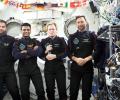
Astronaut Shubhanshu Shukla and the Axiom-4 crew are completing experiments on the International Space Station (ISS) before their scheduled return to Earth.

The Axiom-4 mission, marking the return to space for India, Hungary and Poland, blasted off from the Kennedy Space Centre in Florida at 12:01 pm on Wednesday.

Indian astronaut Shubhanshu Shukla, currently on the ISS as part of the Axiom-4 mission, has acknowledged ISRO's efforts in ensuring his safe travel. He spoke with ISRO chairman V Narayanan about his well-being and the experiments being conducted on the ISS.

Shubhanshu Shukla's first seven days in space have combined science, ceremony, and moments of levity.

The move follows a quiet visit by National Security Advisor Ajit Kumar Doval to the Vikram Sarabhai Space Centre in Thiruvananthapuram.

India's Group Captain Shubhanshu Shukla and three other astronauts on Thursday reached the International Space Station as the Dragon spacecraft docked with the orbital laboratory.

The three principles he taught in particular -- Ahimsa, Anekantavada and Aparigraha -- are as alive and necessary today as they were then. Perhaps more so.
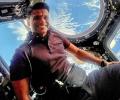
Indian astronaut Shubhanshu Shukla conducts experiments on the International Space Station, focusing on seed germination, microalgae deployment, and stem cell research in microgravity.

Shukla shared these details in an 18-minute interaction with Prime Minister Narendra Modi on Saturday from the International Space Station that is orbiting the earth at an altitude of 400 km.

'Many of the children I work with had never attended school before and had never been given the right environment or opportunity to learn.'
'When education became accessible -- through flexible learning spaces, creative methods and community-based classrooms -- these same children began to thrive.'
'Over time, many who had never stepped into a formal classroom not only entered the education system but continued their studies further, with some going on to university.'

President Droupadi Murmu addressed Parliament, urging unity on national issues like 'Viksit Bharat', swadeshi, and national security. She highlighted government initiatives and the nation's progress.

NASA, Axiom Space, and SpaceX are now targeting 12.01 PM (IST), Wednesday, June 25, for launch of the fourth private astronaut mission to the International Space Station, Axiom Mission 4, NASA said.

Shukla, who goes by the nickname "Shux", will be the second Indian to travel to space, 41 years after his idol Rakesh Sharma undertook a spaceflight in 1984 onboard erstwhile Soviet Union's Soyuz spacecraft for an eight-day stay in orbit.

Meanwhile, Musk said some parts of the ISS were "simply getting too old and obviously that risk grows over time."

Both sides have now revealed a preference for escalation over strategic defeat, and each new provocation narrows the space for the next pause. The Touska seizure, Iran's refusal to negotiate under blockade, Israel's strikes on Iranian oil infrastructure -- all of these add up to an increasingly untenable situation. This makes the wild card -- Trump and his motormouth -- more consequential than ever, notes Prem Panicker in his must read blog on the Iran War.

As the first stage was crossed, Shukla sent a first message from space, saying he, along with the crew, was orbiting Earth at a speed of 7.5 km per second.
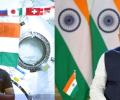
Shukla created history on Wednesday by embarking on a journey to the International Space Station (ISS) as part of a commercial mission operated by Axiom Space, along with three other astronauts.

Group Captain Shubhanshu Shukla, India's second astronaut, shares his journey from a shy child hearing stories of Rakesh Sharma to becoming part of the Axiom-4 mission to the International Space Station. He emphasizes the role of the IAF in his transformation and inspires India's youth to explore space.

The 'rescue' operation occurred within kilometres of Iran's underground tunnel complex at Isfahan, assessed by the IAEA and US intelligence as holding a substantial portion of the country's 60 per cent enriched uranium stockpile. Retired senior US military officers have highlighted that the mission's footprint -- hundreds of special operators, multiple heavy-lift aircraft deep inside Iran -- appears outsized for recovering a single airman. Prem Panicker continues his must read blog on the Iran War.

Unveiling his launch day playlist, the Indian pilot revealed that he loves to listen to Shah Rukh Khan's Swades song Yuh Hi Chala Chal.

Indian Air Force Group Captain Shubhanshu Shukla, the first Indian to visit the International Space Station, received a hero's welcome in his hometown of Lucknow. Celebrations included family, supporters, a roadshow, and recognition from government officials.

Opposition leaders have criticised Prime Minister Narendra Modi's address to the nation, calling it politically motivated and a misuse of official platforms during ongoing elections.
Indian astronaut Shubhanshu Shukla will enjoy a range of Indian dishes, including rice varieties, moong dal halwa, and mango nectar, during his 14-day mission aboard the International Space Station (ISS). He will also have the option to choose from international cuisine, as approved by NASA. ISRO and DRDO have developed the Indian food options for astronauts of the Gaganyaan mission and Shukla will be able to savor them with NASA's approval.

From a surge in startups to crewed mission preparations, 2025 marks a transformative year as India eyes $44 billion space economy by 2033.
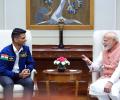
Shukla said the two missions presented a major opportunity for the country and the sustained commitment of the government to the space sector, despite setbacks such as the Chandrayaan-II mission was laudable.
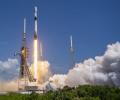
'ISRO recommended to carry out in-situ repairs or replacement and conduct a low-temperature leak test to validate system performance and integrity, before proceeding with launch.'

This mission is the 14th human flight for the New Shepard programme and the 34th in its history.

Kamna Shukla, wife of astronaut Shubhanshu Shukla, shares plans for his homecoming after his 18-day mission on the International Space Station, emphasizing family time and simple pleasures.

The ceasefire is still technically holding, to the extent that no overt hostilities have been reported yet, but the rhetoric has hardened dangerously. The week ahead will also clarify whether the Islamabad failure was a negotiating tactic or whether Washington has genuinely locked itself into a position from which the only exits are climb-down, escalation, or the slow bleed of a new status quo that nobody chose and nobody controls. Prem Panicker continues his must read blog on the Iran War.
 © 2026 Rediff.com - Advertise with us - Disclaimer - Privacy Policy - Sitemap - Feedback - About us - Terms of use - Grievances